
printf("ho_tari\n");
5일차 본문
2025.06.17
07.myexecl.c
#include <stdio.h>
#include <stdlib.h>
#include <unistd.h>
#include <sys/types.h>
#include <wait.h>

int main(void) {
	pid_t pid;
	int status;
	switch (pid=fork()) {
		case -1:
			perror("fork failed");
			break;
		case 0:				// child process
			printf("CHILD PROCESS : %d\n", getpid());
			if(execl("./01.mytask", "01.mytask", "10", (char *) 0) == -1)
				perror("execl");
		default:
			sleep(1);
			system("ps -lf");
			pid = wait(&status);
			printf("parent : waited (%d) and completed!\n", pid);
			exit(0);
	}
	return 0;
}
07-1.myexecl.c
#include <stdio.h>
#include <stdlib.h>
#include <unistd.h>
#include <sys/types.h>
#include <wait.h>

void handler(int signo) {
	pid_t exit_pid;
	printf("\nhandler_pid [%d], handler_ppid [%d]\n", getpid(), getppid());
	exit_pid = waitpid(-1, NULL, WNOHANG);
	if(exit_pid == -1)
		perror("waitpid");
	else
		printf("Terminated child PID = %d\n", exit_pid);
}

int main(void) {
	pid_t pid;

	signal(SIGCHLD, handler);
	switch (pid=fork()) {
		case 0:				// child process
			printf("CHILD PROCESS : %d\n", getpid());
			char *args[] = {"01.mytask", "10", NULL};
			if(execv("./01.mytask", args) == -1)
				perror("execv");
			exit(100);
		default:
			getchar();
	}
	return 0;
}
08.mydaemon.c
#include <stdio.h>
#include <unistd.h>
#include <sys/types.h>
#include <sys/stat.h>
#include <syslog.h>
#include <fcntl.h>
#include <stdlib.h>
#include <time.h>
#include <syslog.h>

int main(void) {
	pid_t pid, sid;
	int fd, fd0, fd1, fd2;
	time_t now;

	if((pid = fork()) != 0) {
		exit(0);																							//parent exit
	}
	sid=setsid();
	umask(0022);
	chdir("/");
	close(STDIN_FILENO); close(STDOUT_FILENO); close(STDERR_FILENO);
	fd = open("/tmp/mydaemon.log", O_WRONLY | O_CREAT | O_TRUNC, 0666);
	dup2(fd, 1); dup2(fd, 2);
	while(1){
		time(&now);
		fprintf(stdout, "Mydaemon alive at %s", ctime(&now));
		fflush(stdout); 																			/* flush the stream */
		sleep(5);
	}
	return 0;
}
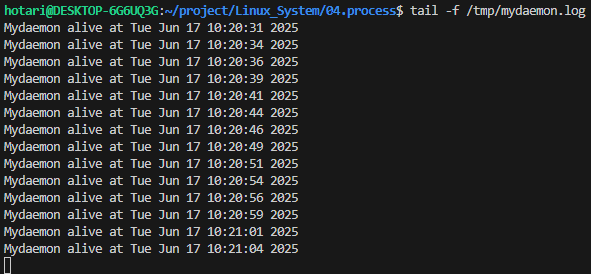
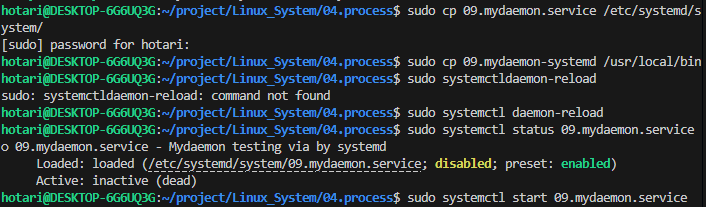
09.mydaemon.service
[Unit]
Description=Mydaemon testing via by systemd
[Service]
ExecStart=/usr/local/bin/09.mydaemon-systemd
Restart=on-failure
Type=forking
PIDFile=/run/mydaemon.pid
[Install]
WantedBy=multi-user.target
09.mydaemon-systemd.c
#include <stdio.h>
#include <unistd.h>
#include <sys/types.h>
#include <sys/stat.h>
#include <syslog.h>
#include <fcntl.h>
#include <stdlib.h>
#include <time.h>
#include <signal.h>

void sigHandler(int sig);

int fd;
const char pidfile[] = "/run/mydaemon.pid";
const char daemonlog[]="/tmp/mydaemon.log";

int main(int argc, char * argv[]) {
	pid_t pid, sid;
	time_t now;
	struct sigaction action;

	if((pid = fork()) != 0) {
		exit(0);									//parent exit and child continues
	}

	if((pid = fork()) !=0 ) {		//double forking
		exit(0);
	}

	sid=setsid();
	if ((fd = open(pidfile, O_RDWR | O_CREAT)) == -1){
			perror("Can't open file for writing");
			return 1;
	}
	dprintf(fd, "%d\n", getpid());

	umask(0);
	if(chdir("/") !=0 ) {
		perror("chdir");
		exit(1);
	}

	close(STDIN_FILENO); close(STDOUT_FILENO); close(STDERR_FILENO);

	/* prepare for sigaction */
	action.sa_handler = sigHandler;
	sigfillset(&action.sa_mask);
	action.sa_flags = SA_RESTART;
	/* register the signals we want to handle */
	sigaction(SIGTERM, &action, NULL);
	sigaction(SIGINT, &action, NULL);
	sigaction(SIGQUIT, &action, NULL);
	sigaction(SIGABRT, &action, NULL);

	if((access(daemonlog, F_OK)) == 0){
	   unlink(daemonlog);
   }

	if ((fd = open(daemonlog, O_CREAT | O_RDWR | O_TRUNC, 0644)) == -1){
		perror("Can't open daemonlog");
		return 1;
	}
	while(1){
		time(&now);
		dprintf(fd, "Mydaemon alive at %s", ctime(&now));
		sleep(5);
	}
	return 0;
}

void sigHandler(int sig){
    int status = 0;
    if ( sig == SIGTERM || sig == SIGINT || sig == SIGQUIT || sig == SIGABRT ){
        if ((unlink(pidfile)) == -1)			/* remove the pid-file */
            status = 1;
        if ((close(fd)) == -1)
            status = 1;
		if ((unlink(daemonlog)) == -1)			/* remove the daemonlog */
            status = 1;
        exit(status); 							/* exit with the status set*/
    }else{										/* some other signal */
        exit(1);
    }
}
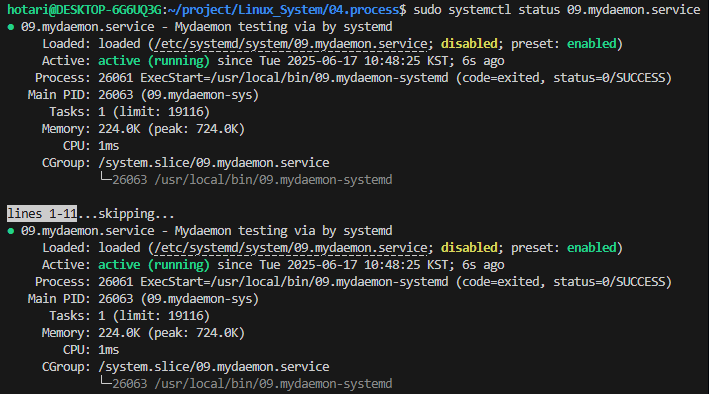
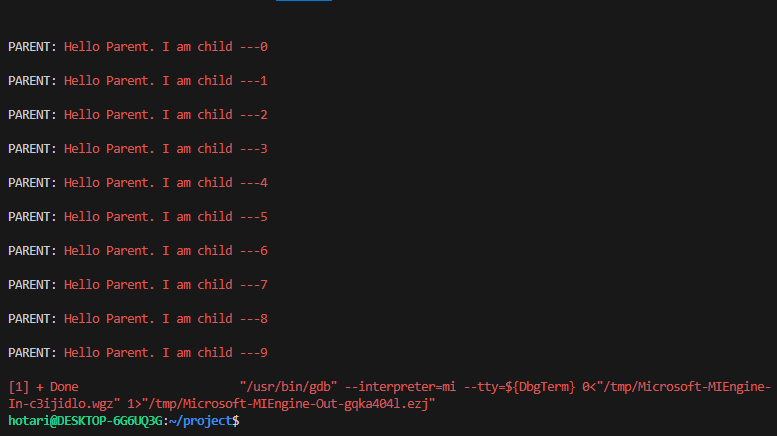
01.mypipe1.c
#include <stdio.h>
#include <string.h>
#include <stdlib.h>
#include <unistd.h>
#include <sys/types.h>
#include <time.h>

int main(void) {
	int pd[2], read_fd, write_fd;
	pid_t pid;
	time_t timer1, timer2;
	char tx_buf[100], rx_buf[100];

	if ( pipe(pd) == -1 ) {
		perror("pipe");
		exit(1);
	}

	read_fd = pd[0];
	write_fd = pd[1];

	switch(pid=fork()) {
		case 0:
			close(read_fd);
			for(int i=0; i<11; i++){
				// for(timer1=time(NULL); time(NULL)<timer1 + 1;)
				// continue;
				// strcpy(tx_buf, "\e[31mHello Parent. I am child.");
				sprintf(tx_buf, "\e[31mHello Parent. I am child ---%d\n", i);
				write(write_fd, tx_buf, strlen(tx_buf)+1);
				for(timer1=time(NULL); time(NULL)<timer1 + 1;)
				continue;
				// read(read_fd, rx_buf, sizeof(rx_buf));
				// printf("\e[00m--------> CHILD: %s\n", rx_buf);
			}
			exit(0);
		default:
#if 1
			close(write_fd);
			for(int i=0; i<10; i++){
				// for(timer2=time(NULL); time(NULL)<timer2 + 2;)
					// continue;
				// memset(&rx_buf[0], 0, sizeof(rx_buf));
				read(read_fd, rx_buf, sizeof(rx_buf));
				printf("\e[00mPARENT: %s\n", rx_buf);
				// for(timer2=time(NULL); time(NULL)<timer2 + 2;)
					// continue;
				// strcpy(tx_buf, "\e[00mHello Child. I am Parent");
				// sprintf(tx_buf, "\e[00mWeleome Child. I am Parent--%d\n", i);
				// write(write_fd, tx_buf, strlen(tx_buf)+1);
			}
#else
			for(int i=0; i<10; i++){
				for(timer2=time(NULL); time(NULL)<timer2 + 2;)
					continue;
				strcpy(tx_buf, "\e[00mHello Child. I am Parent");
				write(write_fd, tx_buf, strlen(tx_buf)+1);
				read(read_fd, rx_buf, sizeof(rx_buf));
				printf("\e[00mPARENT: %s\n", rx_buf);
			}
#endif
			exit(0);
	}
}
02.mypipe2.c
#include <stdio.h>
#include <string.h>
#include <stdlib.h>
#include <unistd.h>
#include <string.h>
#include <time.h>

#define MSGSIZE	64

int main(void){
	int pd1[2], pd2[3];
	pid_t ret;
	time_t timer1;
	char sbuf[MSGSIZE];
	char rbuf[MSGSIZE];
	int i, len;

	if(pipe(pd1) == -1){
		perror("pipe1");
		exit(1);
	}

	if(pipe(pd2) == -1){
		perror("pipe2");
		exit(1);
	}


	switch(fork()){
		case 0:					//child
			close(pd1[0]);
			close(pd2[1]);
			for(i=0; i<5; i++) {
				sprintf(&sbuf[0], "Hello, Parent #%d", i+1);
				write(pd1[1], sbuf, strlen(sbuf));

				memset(&rbuf[0], 0, MSGSIZE);
				len = read(pd2[0], rbuf, MSGSIZE);
				if(len == 0){
					break;
				}
				printf("CHILD: %s\n", rbuf);
				for(timer1=time(NULL); time(NULL)<timer1 + 1;)
					continue;
			}
			exit(0);
		default:				//parent
			close(pd1[1]);
			close(pd2[0]);
			for(i=0; ; i++) {
				memset(&rbuf[0], 0, MSGSIZE);
				len = read(pd1[0], rbuf, MSGSIZE);
				if(len == 0){
					break;
				}
				printf("PARENT: %s\n", rbuf);
				for(timer1=time(NULL); time(NULL)<timer1 + 1;)
					continue;
				sprintf(&sbuf[0], "Welcome, Child #%d", i+1);
				write(pd2[1], sbuf, strlen(sbuf));
			}
	}
	return 0;
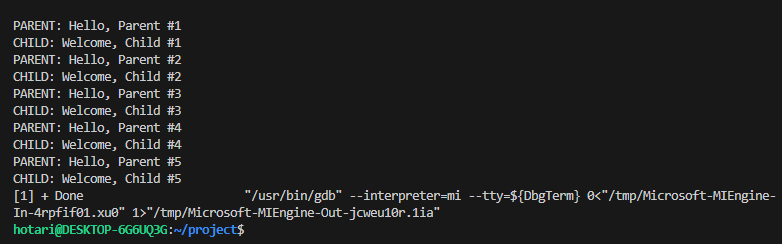
}
03.myfifo_recv.c
#include <sys/types.h>
#include <sys/stat.h>
#include <fcntl.h>
#include <unistd.h>
#include <stdio.h>
#include <stdlib.h>
#include <string.h>

int main(){
	int fd;
	char buf[128];
	int count = 0;

	if((access ("/tmp/myfifo", F_OK)) != 0){
		if(mkfifo("/tmp/myfifo", S_IRUSR | S_IWUSR) == -1){
			perror("mkfifo");
			exit(1);
		}
	}

	if((fd = open("/tmp/myfifo", O_RDONLY)) == -1){
		perror("open");
		exit(1);
	}

	while(1){
		memset(buf, 0, sizeof(buf));
		read(fd, buf, sizeof(buf));
		printf("Rx - %s\n", buf);
		if(strstr(buf, "end")){
			break;
		}
	}
	close(fd);
	unlink("/tmp/myfifo");
	return 0;
}
04.myfifo_send.c
#include <sys/types.h>
#include <sys/stat.h>
#include <fcntl.h>
#include <unistd.h>
#include <stdio.h>
#include <stdlib.h>
#include <string.h>
#include <time.h>

int main(){
	int fd, i;
	char buf[128];
	time_t timer1;

	if((fd = open("/tmp/myfifo", O_WRONLY)) == -1){
		perror("open");
		exit(2);
	}

	for(i=0; i<5; i++){
		memset(buf, 0, sizeof(buf));
		sprintf(&buf[0], "Hello(%d)", i);
		write(fd, &buf[0], strlen(buf)+1);
		printf("Tx: %s\n", buf);
		for(timer1=time(NULL); time(NULL)<timer1 + 2;)
			continue;
	}
	memset(buf, 0, sizeof(buf));
	sprintf(buf, "end");
	write(fd, buf, strlen(buf)+1);
	close(fd);
	/* unlink("/tmp/mkfifo"); */
	return 0;
}
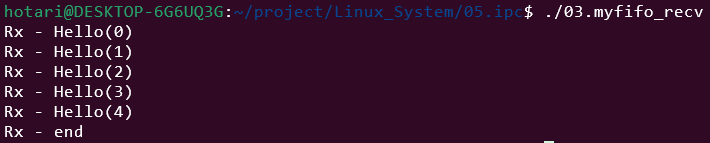
03.posix_shm_write.c
#include <stdio.h>
#include <unistd.h>
#include <sys/mman.h>
#include <sys/stat.h>
#include <fcntl.h>
#include <string.h>

#define  MEM_SIZE    128

int main() {
	int fd;
	void *shm_addr;
	const char *message0= "Welcome to ";
	const char *message1= "Linux Systems ";
	const char *message2= "Programming!";


	fd = shm_open("/mydata", O_RDWR | O_CREAT, 0666);


	ftruncate(fd, MEM_SIZE);


	shm_addr = mmap(0, MEM_SIZE, PROT_WRITE, MAP_SHARED, fd, 0);
	printf( "Map addr is %p\n", shm_addr );
#if 1
	write(fd, message0, strlen(message0));
	write(fd, message1, strlen(message1));
	write(fd, message2, strlen(message2));
#else
	memcpy(shm_addr, message0, strlen(message0));
	shm_addr += strlen(message0);
	sprintf(shm_addr, message1, strlen(message1));
	shm_addr += strlen(message1);
	memcpy(shm_addr, message2, strlen(message2));
	shm_addr += strlen(message2);
#endif
	printf("Press enter to munmap.... ");
	getchar();
	munmap(shm_addr, MEM_SIZE);
	return 0;
}
04.posix_shm_read.c
#include <stdio.h>
#include <unistd.h>
#include <stdlib.h>
#include <sys/mman.h>
#include <sys/stat.h>
#include <fcntl.h>
#include <string.h>

#define  MEM_SIZE    128

int main() {
	int fd;
	void *shm_addr;
	char buf[MEM_SIZE];

	fd = shm_open("/mydata", O_RDONLY, 0666);
	if(fd == -1){
		perror("shm_open");
		exit(1);
	}


	shm_addr = mmap(0, MEM_SIZE, PROT_READ, MAP_SHARED, fd, 0);
	if(shm_addr == (void *)-1){
		perror("mmap error");
		return EXIT_FAILURE;
	}
#if 1
	memset(buf, 0, MEM_SIZE);
	read(fd, buf, MEM_SIZE);
	printf("%s\n", buf);
#else
	memcpy(buf, shm_addr, sizeof(buf));
	printf("Map addr is %p\n", shm_addr);
	printf("Read message: %s\n", buf);
#endif
	printf("Press enter to munmap .....");
	getchar();
	munmap(shm_addr, MEM_SIZE);
	printf("Press enter to remove shared memory file");
	getchar();
	shm_unlink("/mydata");
	// close(fd);
	return 0;
}
03.posix-mqsend.c
#include <stdio.h>
#include <mqueue.h>
#include <fcntl.h>
#include <sys/stat.h>
#include <sys/types.h>
#include <string.h>
#include <unistd.h>
#define MAX_MSG_SIZE 2048

int main(int argc, char *argv[]){
	int mqd; /* msg queue descriptor */
	/* attributes for the message queue */
	struct mq_attr msgattr;
	msgattr.mq_maxmsg = 10;
	msgattr.mq_msgsize = MAX_MSG_SIZE;
	char msg[128];

	mqd = mq_open("/myqueue", O_CREAT|O_RDWR, 0644, &msgattr);
	if(mqd == -1){
	  perror("Creating message queue");
	  return 1;
	}
	for(int i=0; i<10; i++){
		sprintf(&msg[0], "Hello, message queue #%d", i+1);
		if((mq_send(mqd, msg, strlen(msg), 1)) == -1){
			perror("Message queue send");
			return 1;
		}
	}
	printf("Press Enter to remove message queue....");
	getchar();

	mq_close(mqd);
	mq_unlink("/myqueue");
	return 0;
}
03.posix-mqrecv.c
#include <stdio.h>
#include <mqueue.h>
#include <fcntl.h>
#include <sys/stat.h>
#include <sys/types.h>
#include <stdlib.h>
#include <string.h>

int main(void){
   int mqd; 								/* msg queue descriptor */
   char *buffer;
   struct mq_attr msgattr;
   mqd = mq_open("/myqueue", O_RDONLY);
   if(mqd == -1){
      perror("Open message queue");
      return 1;
   }
   if((mq_getattr(mqd, &msgattr)) == -1){
      perror("Get message attribute");
      return 1;
   }
   buffer = calloc(msgattr.mq_msgsize, sizeof(char));
   if(buffer == NULL){
      fprintf(stderr, "Couldn't allocate memory");
      return 1;
   }
   printf("%ld messages in queue\n", msgattr.mq_curmsgs);
   for(int i = 0; i<msgattr.mq_curmsgs; i++){
      if((mq_receive(mqd, buffer, msgattr.mq_msgsize, NULL)) == -1){
         perror("Message receive");
         return 1;
      }
      printf("%s\n", buffer);
   }
   memset(buffer, '\0', msgattr.mq_msgsize);
   free(buffer);
   mq_close(mqd);
   //mq_unlink("/myqueue");
   return 0;
}
03.shm_posix_named_sem1.c
#include <semaphore.h>
#include <sys/types.h>
#include <fcntl.h>
#include <sys/stat.h>
#include <unistd.h>
#include <sys/shm.h>
#include <sys/mman.h>

#include <stdlib.h>
#include <stdio.h>

#define KEY_NUM     0x2222
#define	MEM_SIZE		1024

int main(int argc, char **argv) {
  sem_t *mysem;
	int shm_id;
	void *shm_addr;

	printf("Started --------------------\n");
	if((shm_id = shmget((key_t)KEY_NUM,MEM_SIZE,IPC_CREAT|0666)) == -1) {
		perror("shmget");
		exit(1);
	}

	if((shm_addr = shmat(shm_id, NULL, 0)) == (void *)-1) {
		perror("shmat");
		exit(1);
	}

	printf("Named semaphore ---------------\n");
  if((mysem = sem_open("/mysemaphore", O_CREAT, 0777, 1)) == NULL) {
    perror("Sem Open Error");
    return 1;
  }

  for(int i=0; i<500; i++){
#ifdef SEM
    sem_wait(mysem);
#endif
		sprintf((char *)shm_addr, "%d", getpid());
		for(int j=0; j<5000000; j++){}
		if(getpid() == atoi(shm_addr))
			putchar('0');
		else
			putchar('X');
		fflush(stdout);
#ifdef SEM
		sem_post(mysem);
#endif
    }
	if(shmdt(shm_addr) !=0){
		perror("shmdt");
		exit(2);
	}
	sem_close(mysem);
	sem_unlink("/mysemaphore");
	if(shmctl(shm_id, IPC_RMID, NULL) == -1){
		perror("shmctl");
		exit(2);
	}
}

// sem.mysem file for mysem semaphore is located in /dev/shm
// To compile the program, -lrt & -lpthread is required
04.shm_posix_named_sem2.c
#include <semaphore.h>
#include <sys/types.h>
#include <fcntl.h>
#include <sys/stat.h>
#include <unistd.h>
#include <sys/shm.h>
#include <sys/mman.h>

#include <stdlib.h>
#include <stdio.h>

#define KEY_NUM     0x2222
#define	MEM_SIZE	1024

int main(int argc, char **argv){
	sem_t *mysem;
	int shm_id;
	void *shm_addr;

	printf("Started --------------------\n");
	if((shm_id = shmget((key_t)KEY_NUM,MEM_SIZE,IPC_CREAT|0666)) == -1) {
		perror("shmget");
		exit(1);
	}

	if((shm_addr = shmat(shm_id, NULL, 0)) == (void *)-1) {
		perror("shmat");
		exit(1);
	}

	printf("Named semaphore ---------------\n");
	if((mysem = sem_open("/mysemaphore", O_CREAT, 0777, 1)) == SEM_FAILED) {
			perror("Sem Open Error");
			return 1;
	}

	for(int i=0; i<500; i++){
#ifdef SEM
		sem_wait(mysem);
#endif
		sprintf((char *)shm_addr, "%d", getpid());
		for(int j=0; j<3000000; j++){}
		if(getpid() == atoi(shm_addr))
			putchar('0');
		else
			putchar('X');
		fflush(stdout);
#ifdef SEM
		sem_post(mysem);
#endif

	}
	if(shmdt(shm_addr) !=0){
		perror("shmdt");
		exit(2);
	}
	sem_close(mysem);
	sem_unlink("/mysemaphore");
}
'(Telechips) AI 시스템 반도체 SW 개발자 교육 > SoC 시스템 반도체를 위한 임베디드 리눅스' 카테고리의 다른 글
| 7일차 (0) | 2025.06.20 |
|---|---|
| 6일차 (0) | 2025.06.18 |
| 4일차 (0) | 2025.06.16 |
| 3일차 (0) | 2025.06.13 |
| 1일차 (0) | 2025.06.10 |
'(Telechips) AI 시스템 반도체 SW 개발자 교육/SoC 시스템 반도체를 위한 임베디드 리눅스' Related Articles
more


